Showing posts with label Tech. Show all posts

Monday, 15 April 2013

Google rivals may be quizzed on antitrust offer this week


Google rivals may be quizzed on antitrust offer this week

The Google signage is seen at the company's headquarters in New York January 8, 2013. REUTERS/Andrew KellyReuters/Reuters - The Google signage is seen at the company's headquarters in New York January 8, 2013. REUTERS/Andrew Kelly

By Foo Yun Chee
BRUSSELS (Reuters) - Google's rivals could get the chance to ramp up pressure for tougher concessions from the search giant when they are asked, possibly as early as this week, to study its proposals for ending an EU antitrust investigation.
The world's most popular search engine formally submitted a package of concessions to European regulators last week and three people familiar with the matter said on Monday these could be put to rivals this week in a market test.
The proposals are intended to settle an investigation dating from November 2010 and stave off a fine that could be as high as $5 billion if the company were found to have breached EU rules.
"It is possible the market test could start this week," said one of the sources, who declined to be identified because of the sensitivity of the matter.
The spokesman for competition policy at the European Commission, Antoine Colombani, declined to comment. Google spokesman Al Verney said the company continued to work cooperatively with the EU antitrust watchdog.
Complainants against Google include Microsoft, online mapping services, smaller rival search engines across Europe, publishers, online travel sites such as TripAdvisor and Expedia, and price comparison sites.
Neither the Commission nor Google have given details of the proposals. But people familiar with the matter have told Reuters these could include Google labeling its own services to differentiate them from rivals', and also imposing fewer restrictions on advertisers.
Google's opponents have already indicated labeling will not address their concerns.
"Labeling is a non-starter and may be worse than the existing situation," said David Wood, a lawyer for online lobbying group ICOMP, whose members include Microsoft and four other complainants.
Any concessions the regulators accept from Google will be valid for five years in Europe and be monitored by a trustee to ensure compliance, one of the sources said.
"Rival services will be shown more prominently in search results, with three links to three different search engines," this person said.
"Advertising space in Google Shopping will be reserved exclusively for vertical search sites," the person said, referring to specialty search functions focused on specific topics.
Rivals can also mark out sensitive information such as addresses, telephone numbers, opening hours and reviews which they do not want Google to use.
"This is especially for local search sites and product search sites, such as online travel site TripAdvisor and Nextag," the person said.
The Financial Times first reported on the details of Google's offer.

MetroPCS urges shareholders to vote for amended T-Mobile deal


MetroPCS urges shareholders to vote for amended T-Mobile deal

The logo of Deutsche Telekom AG is seen outside the company's headquarter in Bonn May 24, 2012. REUTERS/Wolfgang Rattay
(Reuters) - MetroPCS Communications amended the terms for its proposed merger with Deutsche Telekom unit T-Mobile USA, and asked shareholders to vote for the deal.
The move follows Deutsche Telekom sweetening its offer last Wednesday, bowing to pressure from activists and proxy advisory firms.
MetroPCS's shares, which closed at $11.52 on the New York Stock Exchange on Friday, were down 2 percent in premarket trading.
The amendment "significantly improves" the value of the proposed combination for shareholders, MetroPCS's board said in a statement.
The new terms include reducing the combined company debt by $3.8 billion to $11.2 billion and lowering the interest rate on the debt by 50 basis points.
As a part of its sweetened offer, Deutsche Telekom has expanded the lock-up period - when it is prohibited from publicly selling shares in the company - by 12 months to 18 months.

Vodafone to cut 500 jobs in Germany


Vodafone to cut 500 jobs in GermanyA customer walks past the Vodafone logo in a shopping mall in Prague February 7, 2012. British telecommunication firm Vodafone is expected to post fourth-quarter results on February 9. REUTERS/David W Cerny

FRANKFURT (Reuters) - Vodafone will cut 500 jobs in Germany, the company said on Monday, as the group adjusts to harsher competition and lower fees in Europe's largest economy.
"We have started a two-year program," a spokesman said, confirming reports in the Frankfurter Allgemeine Zeitung and Rheinische Post.
The company aims to shift some operations to Romania and India, as well as considerably reduce starting salaries. Areas like network technology and customer service will be affected.
Vodafone is suffering because of low price offers for smartphones from Deutsche Telekom's T-Mobile unit and a regulatory ruling that lowers the fees mobile operators can charge for calls coming from other networks.

iPhone supplier Japan Display turns to smaller smartphone makers


iPhone supplier Japan Display turns to smaller smartphone makers

By Reiji Murai and Mari Saito
TOKYO (Reuters) - Japan Display Inc, one of two Japanese producers of Apple Inc iPhone screens, wants to boost sales by up to 60 percent by winning more business from smaller makers of phones and tablets to offset lackluster orders from its bigger clients.
Japan Display, the world's No.1 maker of small to mid-size panels, may increase sales to as much as 800 billion yen ($8.10 billion) for the fiscal year ending March 2014 from slightly below 500 billion yen a year earlier, said Shuichi Otsuka, CEO of the unlisted firm.
The company, formed out of a merger of the small panel divisions of Sony Corp, Hitachi Ltd and Toshiba Corp last April, does not publicly identify its clients but is widely known as a key Apple supplier. Apple undershot Wall Street's sales forecast for the third straight quarter in the three months ended December after iPhone sales missed expectations.
"Before the fourth quarter, we thought we were going to have quite a loss... It was quite a drastic cut (in orders)," said Otsuka in an interview on Monday, without identifying Japan Display's customers.
Operating margins came in below 1 percent in the last fiscal year, Otsuka said.
Japan Display cut costs, boosted productivity at its plants and was able to recover from the October-December loss with sales to other smaller clients.
"We must continue to aggressively chase the big clients...but we continue to talk to clients whom we think hold great possibilities," he said.
The company, whose top shareholder is the government with a 70 percent stake, may proceed with its initial public offering at the earliest in fiscal year 2014, or the following year at the latest, Otsuka said.
Japan Display competes with domestic rival Sharp Corp, as well as South Korea's LG Display Co Ltd.
Samsung Electronics Co Ltd and Apple combined own more than 71 percent share of the global smartphone market, with the rest split among firms such as LG Electronics Inc, ZTE Corp and Huawei Technology Co Ltd.

U.S. agency denies data center to monitor citizens' emails


U.S. agency denies data center to monitor citizens' emails

WASHINGTON (Reuters) - The U.S. National Security Agency on Monday denied that a $1.2 billion data center it is building in the Utah desert will be used to illegally eavesdrop on or monitor the emails of U.S. citizens.
The secretive agency, which serves the U.S. military and intelligence communities, insisted the state-of-the-art facility's work would be used to support U.S. cybersecurity in accordance with U.S. laws that limit spying on U.S. citizens.
"Many unfounded allegations have been made about the planned activities of the Utah Data Center," the NSA said in a statement, noting that "one of the biggest misconceptions about NSA is that we are unlawfully listening in on, or reading emails of, U.S. citizens. This is simply not the case."
Fox News aired a television report about the 1-million-square-foot (92,903-square-meter) facility on Friday in which former NSA employees raised concerns that the facility would be used to monitor the emails of U.S. citizens.
The NSA said it remained "unwavering" in its respect for U.S. laws and American citizens' civil liberties, and noted that it was subject to broad oversight by all three branches of government.
All wiretapping of U.S. citizens by the NSA requires a warrant from a three-judge court set up under the Foreign Intelligence Surveillance Act passed in 1978.
Former President George W. Bush issued an executive order shortly after the September 11, 2001 attacks on the United States that authorized the NSA to monitor certain phone calls without obtaining a warrant.
The NSA issued a news release about construction of the massive, Utah data center in January 2011, identifying it as the largest Pentagon facility construction project in the country.
It said the project would result in 5,000 to 10,000 new jobs during the construction phase, with 100 to 200 permanent employees to work there once it was completed. The U.S. Army Corps of Engineers is handling the construction of the facility.
NSA spokeswoman Vanee Vines said the center was due to be completed in September.
The NSA is the executive agent for the Office of the Director of National Intelligence, and will be the lead agency at the facility, but the center will also help other agencies, including the Department of Homeland Security, in protecting national security networks, according to a NSA news release.

Friday, 12 April 2013

The Death Of Value Investing

The Death Of Value Investing

Most of the best investors in the world are considered value investors. Well, times are changing -- the destructive power of technology is starting to break down companies faster than ever.
Value investing is an investment philosophy that evolved based on the ideas that Ben Graham and David Dodd started teaching at Columbia Business School in 1928. Since I started my career as an investor, value investing was the holy grail of investing. There are many interpretations of what value investing is, but the basic concept is as follows: essentially you want to buy stocks at a discount to their intrinsic value. Intrinsic value is calculated by taking a discount to future cash flows. If the stock price of a company is lower than the intrinsic value by a “margin of safety” (normally ~30% of intrinsic value), then the company is undervalued and worth investing in. Generally, value stocks are companies that are in decline but the market has overreacted to their situation and the stock is trading lower than their intrinsic value.
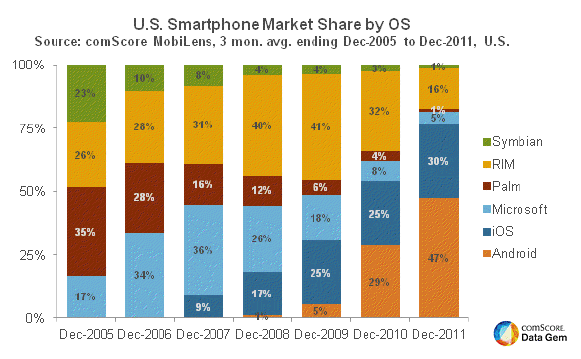
The classic case is Research in Motion (RIM). In January 2007, RIM was trading at a high 55x PE multiple. Over in Cupertino, a computer company called Apple had reinvented itself as an MP3 player company and was now unveiling a new phone set to launch in the summer. By the end of December 2009, market share for Apple’s iPhone iOS as a percentage of US smartphone OS was 25% while RIM had increased from 28% to 41% in that same period. Though RIM had grown market share, fears of iOS growth had toppled the PE multiple to ~17x.

U.S. Smartphone market share by OS
comScore

Many traditional, value investors sat back and thought, “Well, RIM is holding up pretty well compared to the iPhone, yet their PE multiple is getting destroyed.” It’s trading at near the historical average S&P 500 PE multiple of 15x. Apple hasn’t historically been strong in the enterprise, so maybe iPhone will just be a consumer phenomenon that doesn’t break through to business users. Android is irrelevant with 5% market share. The smartphone market is growing rapidly and RIM is the clear leader. RIM is still growing north of 35% and generating nearly $2.5B in net income. I think RIM looks cheap!
Two years later, RIM was trading at a 3.5x PE multiple and topline growth had screeched to a halt. Market share for RIM had contracted to 16% while iOS and Android combined for 77% market share. In fact, in 2012, RIM posted a net income loss of $847mm. Investors lost a ton of cash and were left scratching their heads.
How did this happen so quickly? Why did net income fall off a cliff? Why now?
1. Technology adoption accelerating 
In 1962, Everett Rogers presented his thesis on the diffusion of innovation.

Innovation adoption lifecycle


The idea is that the adoption of new technologies follows a bell curve comprised of innovators (2.5%), early adopters (13.5%), early majority (34%), late majority (34%) and laggards (16%).
The cumulative adoption of technology over time generates what is known as the S-curve. Over the last 100 years, technology adoptions have always followed this same S-curve leading to market saturation.
What has significantly changed is the rate of adoption. The chart below shows technology adoption rates as a percent of US population starting from the point of invention. New technologies are being adopted much faster than ever before. While technologies from the early part of the century like electricity, automobiles and  the telephone took well over 50 years to reach 50% adoption, newer technologies like Internet, PCs, smartphones and tablets are being adopted much faster.
There are several factors that go in to how fast the technology gets adopted, including how discontinuous the innovation is and the per capita income, but the reality is adoption pace is accelerating. The flip side of this is when new technologies get adopted faster, incumbent solutions die faster. Quicker adoption leads to quicker destruction of old technologies.
2. Internet way of life
An individual’s interaction with the world generally takes on 3 forms: consuming, communicating or creating. Historically these 3 mediums required a very different set of products and services to help you get the task done. Today all of this happens digitally.  Historically, when you would consume content, it would be through a television set, listening to the radio or reading a magazine/newspaper. Instead of turning on the TV, I get online and go to Hulu. If I want to watch a movie I go to Netflix. If I want to listen to music, I open my Spotify app on my mobile phone. Nowadays I only read on Twitter, Flipboard or iBooks.
Communication has gone through a similar transformation with the telephone giving way to services like Skype. Even when I want to interact with a service provider, I use a mobile app like Uber or make a reservation on OpenTable. Even the creation of pictures, home movies and voice recordings can all be done on my iPhone. From sharing a photo on Instagram to tracking my activity on a Jawbone UP, everything I do in my life happens in the palm of my hand with my smartphone.
With the Internet controlling so much of our life, it’s no wonder that everyone wants to be connected. The issue for incumbent technologies is that what once cost thousands of dollars and several devices, has all consolidated to a smartphone with a data plan. This kind of massive consolidation has detrimental effects on any company or industry that hasn’t adapted to the massive structural shift.
3. Software Eating the World
In 2011, Marc Andreessen wrote a piece outlining “Why is Software Eating the World” where he noted software-centric companies like Netflix destroying Blockbuster, or Amazon taking down Barnes and Noble as evidence that traditional industries will be eaten alive by their software counterpart. Further to this, software is devouring industries that don’t necessarily compete directly with a software counterpart. The proposed merger of OfficeMax and Office Depot is a
prime example. These are two companies that have struggled over the last few years compared to their rival Staples. Post-merger, the combined entity will have a retail footprint of ~2,000 stores, which will be larger than Staples, but still only 70% of Staples’ revenue. Much of the analysis has focused on increased scale to compete with Staples and Amazon, combined with synergistic efficiencies as the justification of a merger. Thinking that the only reasons these businesses have struggled is due to operational inefficiency and Amazon is absurd. The reality is the core of their very existence is under attack, the office has changed and software is to blame. No longer do people have the need to print out paper and file documents away in those ugly green folders; they store all their documents in a cloud service like Box. When I  need a signature I don’t use a fax machine or FedEx documents; I use Docusign. I don’t even use a notepad anymore; I write notes on my iPad and save in my Evernote account. Printers, fax machines, paper, pens and notebooks are all items that were central to the office 15 years ago but aren’t relevant in the digital office. Software doesn’t just challenge businesses through direct competition; they can upend businesses through a systematic digitization of the world, rendering goods and service that a company is offering obsolete.
With technology upending markets, remaining a value investor is a death sentence. In the case of RIM, the company thought that their scale was defensible and stopped innovating on the operating system, favoring battery life instead. Apple’s iPhone operating system and associated software was an order of magnitude better than RIM and attracted consumers. Interestingly enough, Apple is dangerously close to losing their own software battle to Google with mobile versions of Google Maps, Gmail and Google voice being far better than their iOS counterparts.
While there may still be opportunities for value investing, you need to be cautious of businesses that appear to be on a slow decline. With the rate of technology adoption accelerating, Internet being a way of life and software consuming the world, businesses who refuse to embrace or adapt don’t just slowly decline; they fall off a cliff and take their cash flows with them.

Everything We Know About Microsoft's Next Version Of Windows, 'Windows Blue'


Everything We Know About Microsoft's Next Version Of Windows, 'Windows Blue'


attached image

Microsoft is working on a new version of Windows, which is expected to be available sometime this year.
It's codenamed "Windows Blue" and a lot of details about it have leaked, including an early version that several people were able to install on their PCs and Windows tablets.
That version showed that Microsoft is fixing a lot of stuff that people really hated about Windows 8.
That's important because response to Microsoft's big new operating system, Windows 8, has been pretty underwhelming.

Fred Wilson Explains Why Foursquare Just Took On So Much Debt


Fred Wilson Explains Why Foursquare Just Took On So Much Debt

Foursquare just raised $41 million in debt. Most of it is a loan from Silver Lake, a private equity firm. But some of the money is something called "convertible debt," raised from existing Foursquare investors Andreessen Horowitz, Union Square Ventures, and Spark Capital.
In the following post, Union Square Ventures partner Fred Wilson explains the logic behind the deal.
Reading between the lines, it sounds like if Foursquare had had sold equity, its valuation would have been lousy – or at least down from a previous valuation of $600 million.
The debt deal increases risk/reward for common shareholders, including employees. It increases risk in that if Foursquare can't find a home run, they walk away with nothing. But since debt isn't dilutatitve, it also also increases reward if they can hit that home run.
Here is Fred's post:
I've written about convertible debt a few times on this blog, most notably here and here. My general take on convertible debt is that its very good for the founders and not very good for the investors in seed and early stage investments and a much better solution in late stage financings, which I mention at the end of the second linked post.
We have a good case study on late stage convertible debt today and I thought we should not miss an opportunity to talk about it. My partner Albert blogged about the $41mm Foursquare financing on the USV blog today. You will note that the investors bought convertible debt. And this is a classic situation where convertible debt was the optimal solution for everyone.
In the Foursquare situation, the convertible debt was purchased by a group of insiders led by USV and  Andreeesen Horowitz. Both of our firms have been investors in Foursquare for several rounds and both of us own a meaningful stake in the company. Valuation is somewhat immaterial to us as our stake in the  company is not going to increase much in this round of financing. But valuation is very material to the Foursquare management team because $41mm of capital is going to be dilutive at any valuation that would make sense here.
So the optimal structure is convertible debt. That means this round is not dilutive to the Foursquare management at this time. But it will be dilutive when the debt converts into equity, most likely at the next equity issuance. For the investors, we get the comfort of knowing that eventually our investment will become equity and we will not have to price it. Someone else will.
In Foursquare's specific situation, it makes even more sense because the company has just released an entirely new iOS version which gets iOS to parity with Android and completes the transition toward social search and curation which we all believe better positions the company in the minds of consumers. Also, the revenue model is in its early stages and will be much more developed in the next year. In situations where a valuation inflection point is on the horizon, convertible debt can be an excellent structure for everyone involved. And that is very much the case here.


More US Customers Are Returning The New BlackBerry Phone Than Keeping It, Analyst Report Says*


Blackberry CEO Thorsten Heins
Timothy A. Clary/AFP
Research in Motion CEO Thorsten Heins
BlackBerry's stock is tanking this morning following a report from ITG Investment research that says sales of the company's new BlackBerry Z10 phone are weak in the US.
In many cases, ITG says more people are returning the Z10 than keeping it and overall demand for the phone in the US is very weak.
The Z10 launched in late March on Verizon, T-Mobile, and AT&T, but early reports say those carriers haven't done a great job at promoting the phone. AT&T was the first carrier to sell the phone and many stores didn't even have demo units on display on launch day.
BlackBerry's stock is down 5.4% as of this writing, trading at $13.89 per share.
UPDATE: BlackBerry disagrees. It sent out a statement to all press today saying Z10 returns are normal compared to other smartphones. BlackBerry closed down about 7.7% today.
Here's the statement:
BlackBerry wishes to respond to media coverage today regarding speculation that there have been abnormally high levels of returns of BlackBerry Z10 devices. This is absolutely false. Our data shows that return rates for BlackBerry Z10 devices both in the U.S. and on a global basis are in line with or better than our expectations and are consistent with return rates for other premium smartphones in the market today

Yahoo-Killing Facebook Product Is Finally Here


Yahoo-Killing Facebook Product Is Finally Here


Sheryl Sandberg 2
Justin Sullivan/Getty Images
FBApr 11 08:00PM
28.02
Change
+0.45
% Change
+1.62%
YHOOApr 11 08:00PM
24.48
Change
+0.28
% Change
+1.18%
Last fall, a source close to Yahoo told us that Facebook was working on an advertising product that "kills us."

He said:
"There's a story brewing about a next very big business it's building—one that competes with one of Yahoo's flagship ad products and would kill us."
That product is finally here.
It's called "partner categories."
It allows Facebook advertisers to show ads to people who have purchased, or have shown interest in purchasing, specific categories of products offline — from consumer packaged goods to cars and more.
Facebook can do this thanks to a partnership with a firm called Datalogix.
Datalogix tracks usage of loyalty cards in offline retail stores.
Facebook can, in a privacy-sensitive way, tell who purchased about 50% of all consumer-packaged goods sold in the US.
Datalogix can also track people who have given over identifying information to merchants, asking for more information about their products.
So, for example, Facebook knows which of its users have asked Chevy for brochures on its new Camaro.
The implications of this capability are obviously huge.
Imagine how valuable it will be for Gillette to put ads in front of men who bought new razors, or for Ford to stick a Mustang ad in front of those Camaro shoppers.
That kind of targeting — based on a consumer's signalled intent — is nearly as valuable as Google search targeting, where a consumer has told Google exactly what he or she is looking to buy.
No wonder our Yahoo source was so nervous.
Here's Facebook's blog post announcing the feature:
Today we’re launching partner categories, a new way to target ads to more categories of people. For example, a local car dealership can now show ads to people who are likely in the market for a new car who live near their dealership. To date, advertisers have been able to show ads to people based on their expressed interests on Facebook. Now with partner categories, they can also show ads to people on Facebook based on the products and brands they buy across both desktop and mobile.
Partner categories uses data from select third parties including Acxiom, Datalogix, and Epsilon.  No personal information is shared between Facebook, third parties or advertisers. Partner categories work the same way all targeting on Facebook works. The advertiser only knows the size of the audience and can’t access any information about individuals included in a category. For more on this, see our post here.
Companies have long used this type of targeting off of Facebook, and we are excited to make this available to advertisers of all sizes on Facebook.
At launch, partner categories includes more than 500 unique groups. In addition, partner categories works with other Facebook targeting options, so advertisers can further refine their campaigns to reach only the right people. Ads that are well targeted benefit the advertisers who run them by driving higher return on investment and are a better experience for people who see more relevant ads. 
Partner categories will be available to US advertisers in Power Editor and through the API starting today. Here's a preview:
 

Wednesday, 10 April 2013

Google, AT&T target Austin for high-speed Internet


Google, AT&T target Austin for high-speed Internet

Google homepage logos are seen on a wall at the Google campus near Venice Beach, in Los Angeles, California January 13, 2012. REUTERS/Lucy Nicholson
SAN FRANCISCO/NEW YORK | Tue Apr 9, 2013 6:27pm EDT
(Reuters) - Google Inc said on Tuesday it plans to bring its ultra high-speed Internet and television service to Austin, Texas, next year, prompting AT&T Inc to reveal its own plans to follow suit - if it gets the same terms from local authorities.
AT&T appeared to be making a political point to highlight the heavy regulations that encumber traditional phone companies, analysts said.
 
Google promised to begin connecting homes in Austin by the middle of 2014 with a 1-gigabit-per-second Internet service, roughly 13 times faster than the speediest service AT&T had previously committed to offering and about three times faster than the zippiest available from Verizon Communications.
The Austin launch would be Google's first move to expand its "Google Fiber" service beyond Kansas City, Missouri, introduced last year. Google says the Fiber Internet service is 100 times faster than today's average broadband performance.
But as Google unveiled its plans at an event in Austin that featured Texas Governor Rick Perry, Austin's mayor and other city officials, AT&T issued a challenge to the city to provide a more level playing field.
"AT&T's expanded fiber plans in Austin anticipate it will be granted the same terms and conditions as Google on issues such as geographic scope of offerings, rights of way, permitting, state licenses and any investment incentives," AT&T said in a statement.
The No.2 U.S. telecommunications firm did not provide a time frame for its own planned Gigabit network, which it said would not materially alter its anticipated 2013 capital expenditures.
"AT&T is making the point that they could make a lot more investments in many of their communities, absent the regulatory burdens which every community puts on providers," said Raymond James analyst Frank Louthan.
While Louthan said he did not know what the terms of Google's Austin deal were, he pointed out that Google received various benefits in Kansas City, including preferential right-of-way access, access to data centers, and reduced pole access rates.
"This immediately puts the city of Austin in a box," said Louthan. "They realize that if they actually give that to AT&T and build it, Google may not come."
Austin City spokesman Doug Matthews said there was no "special incentives" for Google. "The negotiated agreement we had with Google, by state law we're obligated to provide to anybody else who wants to offer the same service," Matthews said.
"If AT&T is interested in providing a similar service we're happy to talk to them about that," Matthews said. He noted that Google was committed to connect up to 100 public facilities under the terms of the agreement.
Google, the world's No. 1 Internet search engine, launched its first Google Fiber service in Kansas City in November. The company initially billed the service as a test project to spur development of new Web services and technology but now says it views Google Fiber as a viable business.
The ultra high-speed connections and television offerings are aimed at surpassing those of current providers, such as cable and telecommunications companies, such as AT&T and Time Warner Cable Inc.
As in Kansas City, consumers in Austin will be able to get standalone Gigabit Internet service or a bundle that includes nearly 200 high-definition television channels. Pricing in Austin is still to be determined, Google said.
Google said it will also offer Austin residents free Internet service, at a slower 5 megabit per second rate for seven years, provided they pay a one-time construction fee that was not specified. In Kansas City, the fee is $300.
The city's authorities, as opposed to federal regulators, hold the oversight power over the terms and conditions for AT&T's and Google's projects.
Federal Communications Commission Chairman Julius Genachowski has been a big proponent of growing high-speed internet access across the country and on Tuesday, FCC Commissioner Jessica Rosenworcel welcomed the news from Austin.
"Every effort we can make to make sure we have the highest speeds available is a good one," Rosenworcel said on the sidelines of the National Association of Broadcasters trade show in Las Vegas. "I think it is such an important economic imperative that we need to fire on all fronts at once."
Google shares finished Tuesday up $2.80, or less than 1 percent, at $777.65. Shares of AT&T closed the session up 14 cents, or less than 1 percent, at $37.76.

BNP Paribas to open new online bank: unions


BNP Paribas to open new online bank: unionsA man walks past an automatic teller outside a BNP Paribas bank in central Paris October 26, 2012. REUTERS/Jacky Naegelen

PARIS | Wed Apr 10, 2013 5:17am EDT
(Reuters) - French bank BNP Paribas is set to open a new online bank targeting 500,000 customers in five years as it revamps its retail activities, two union sources told Reuters on Wednesday.
BNP and its rival Societe Generale are cutting costs in their branch networks, where a stagnant economy and consumer belt-tightening have hit revenues and raised the likelihood of branch closures.
 
Although France's biggest bank already offers online banking for its regular retail customers, the new project will be entirely digital, the sources said. French daily Les Echos, which reported the plan on Wednesday, said the new brand might be called "Hello Bank".
The project has a target of 25,000 customers by the end of 2013, one of the union sources said.
"25,000 clients by the end of this year and 500,000 in five years," he said, citing discussions held with BNP's management. "This is what we have been told."
A BNP spokeswoman declined to comment.
BNP said in February it had begun a three-year plan to cut costs annually by 2 billion euros ($2.6 billion), without giving details of potential job cuts. The bank is also eyeing an expansion in Asia, where it wants to hire 1,300 people.

Dell's evaluation of buyout bid flawed: shareholder


Dell's evaluation of buyout bid flawed: shareholder

A Dell computer logo is seen on a laptop at Best Buy in Phoenix, Arizona, February 18, 2010. Dell Inc is expected to releases its fourth quarter earnings report on on Thursday. REUTERS/Joshua Lott
Tue Apr 9, 2013 1:17pm EDT
(Reuters) - Southeastern Asset Management, the activist investor that owns 8.4 percent of Dell Inc, said on Tuesday the computer maker's evaluation of a $24.4 billion leveraged buyout deal with its founder and buyout firm Silver Lake was flawed.
Southeastern published a letter it sent to Dell's board of directors asserting the company's March 29 proxy statement fails to make a compelling case for shareholders to accept the $13.65 per share offer from Michael Dell and Silver Lake. The letter says Dell's special committee did not properly explore all options.
 
Citing excerpts from Dell's proxy statement, Southeastern said the company did not properly explain why it did not entertain a buyout offer that would allow shareholders to elect whether they wanted to be paid in cash or stock. It urged Dell's special committee to negotiate now "in good faith."
Dell has received two alternative buyout proposals from Blackstone Group LP and billionaire investor Carl Icahn that Dell has said could ultimately be expected to result in superior offers. Still, the computer maker has recommended accepting the offer on the table from Michael Dell and Silver Lake.
Southeastern Asset Management, the company's largest shareholder after Michael Dell, has been a staunch opponent of the founder's buyout offer.
Dell was regarded as a model of innovation as recently as the early 2000s, pioneering online ordering of custom-configured PCs and working closely with Asian component suppliers and manufacturers to assure rock-bottom production costs.
But as of 2012's fourth quarter, Dell's share of the global PC market had slipped to just above 10 percent from 12.5 percent a year earlier, according to research house IDC.

Microsoft, Nokia demand EU action over Google's Android


Microsoft, Nokia demand EU action over Google's Android

The Google signage is seen at the company's headquarters in New York January 8, 2013. REUTERS/Andrew Kelly
BRUSSELS | Tue Apr 9, 2013 9:14am EDT
(Reuters) - Companies including Microsoft and Nokia have stepped up pressure on EU antitrust regulators to take action against Google, accusing it of blocking competition in mobile telephony.
The complaint comes as Google attempts to resolve a two-year long investigation by the European Commission into its internet search practices and avert a possible fine that could hit $5 billion, or 10 percent of its 2012 revenue.
More than a dozen companies have voiced their grievances about Google's search practices to the Commission.
The investigation's initial focus was on its desktop search engine, but European Union Competition Commissioner Joaquin Almunia said last year he had received complaints about Google's Android, the world's most popular operating system for smartphones.
Almunia has said he aims to reach a settlement with Google in the latter half of the year. The complainants, however, are frustrated with the pace of his investigation.
 
In a complaint made public on Tuesday by their lobbying group FairSearch, Google's rivals accused the company of using Android to divert traffic to its search engine.
FairSearch's other members include world No. 3 software maker Oracle, online travel sites Expedia and TripAdvisor, French shopping comparison site Twenga, British price comparison site Foundem and U.S.-based adMarketplace.
"Google is using its Android mobile operating system as a 'Trojan Horse' to deceive partners, monopolize the mobile marketplace, and control consumer data," FairSearch's lawyer Thomas Vinje said in a statement.
"Failure to act will only embolden Google to repeat its desktop abuses of dominance as consumers increasingly turn to a mobile platform dominated by Google's Android operating system." he said.
The Commission declined to comment.
Google spokesman Al Verney said the company continued to work cooperatively with the regulator.
Google won a major victory in the United States in January when the Federal Trade Commission ended an investigation without any significant action against the company.

LinkedIn Finished Renovating Its Empire State Building Offices And Gave Us A Tour


LinkedIn Finished Renovating Its Empire State Building Offices And Gave Us A Tour


Linkedin1
Robert Libetti/ Business Insider
Just over a year ago, we visited LinkedIn's New York offices.
Many of the careers site's sales and marketing staff are based there (the tech staff is at the HQ in Mountain View, Calif.)
At the time, only 100 people worked at LinkedIn New York. The company was still refurbishing the office.
Today, the redecorating is mostly done and the office has 280 staffers and is still hiring — its marketing solutions unit is clearly booming. (The company has about 3,500 staff overall.)
This is what it's like to work at LinkedIn in New York.

Monday, 8 April 2013

Apple's iMessage is the DEA's worst nightmare


Apple's iMessage is the DEA's worst nightmare


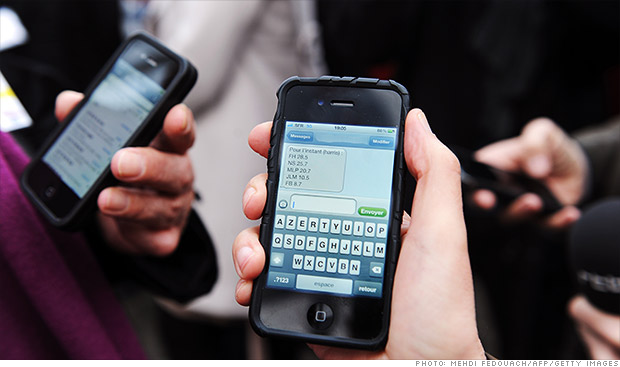
Apple's iMessages are not able to be intercepted by law enforcement.
NEW YORK (CNNMoney)

If you don't want your text messages to be wire-tapped, you might consider getting yourself an iPhone.


Apple's seemingly innocuous iMessage app is giving the U.S. Drug Enforcement Agency endless amounts of grief, because law enforcement is not able to trace and track text message conversations sent via Apple's service. An internal document obtained by CNet reveals that the DEA sees iMessage as "a challenge for DEA intercept."


"IMessages between two Apple devices are considered encrypted communication and cannot be intercepted, regardless of the cell phone service provider," the agency's intelligence note.
The DEA declined comment for this story.
Though iMessage was introduced in 2011, DEA investigators only last month discovered that iMessages were not traceable. The agency sent a memo around internally, because it believed law enforcement may "erroneously believe they have a complete record of text transmissions," when in fact, only non-iMessage texts are able to be collected from an iPhone.
It's been known for a while that the iPhone and its hardware-encrypted iMessage communication protocol was a theoretical boon for those looking to keep their discussions away from the prying authoritarian eyes. If two people using iMessage are having a conversation with one another, it's hard for any person or entity outside of Apple to crack that encryption.
While it is possible to try to directly extract the data from the iPhone's hardware, Technology Review pointed out that it's extremely difficult to get anything from the phone if it is password-protected and is set to wipe its memory after a set number of failed logins.                                                    

Facebook extends pay-to-message trial


Facebook extends pay-to-message trial

A select few Facebook users can now directly message their favorite celebrities but will they like the price?
LONDON (CNNMoney)

Facebook is giving select users in nearly 40 countries around the world access to a trial service that will charge them a fee for sending direct, personal messages to people outside their network.


That means that if you've been trying to get in touch with your favorite celebrity or a secret crush in the office who doesn't know your name, Facebook (FB) may be able to help you out.


Facebook has been testing the pay-to-message concept for some time in the United States.
The price for sending a direct Facebook message will vary based on a number of different factors, including the popularity of the person you're trying to contact and how many other messages are sent their way.
Related: The Facebook phone is here -- sort of
The company said it was still deciding on pricing for the test service, but U.K. media reports say prices will range from the equivalent of about $1 to $15. A small number of users in countries such as the U.K., Australia and Israel would be included in the trial.
"The system of paying to message non-friends in their Facebook inbox is designed to prevent spam, while acknowledging that sometimes you might want to hear from people outside your immediate social circle," said a Facebook spokesperson.But celebrities won't have to worry about a deluge of messages hitting their personal Facebook inboxes just yet. Facebook will limit the number of paid messages a user can receive to one per week.
Users can still send messages to people who are outside of their network for free, but those messages will continue to be routed to a junk folder called the "other" folder, which users rarely read and review.
In December, the company explored the possibility of charging users $100 to send messages to Facebook founder Mark Zuckerberg and other top Facebook executives, such as COO Sheryl Sandburg

Major Bitcoin exchanges hit with cyberattacks


Major Bitcoin exchanges hit with cyberattacks


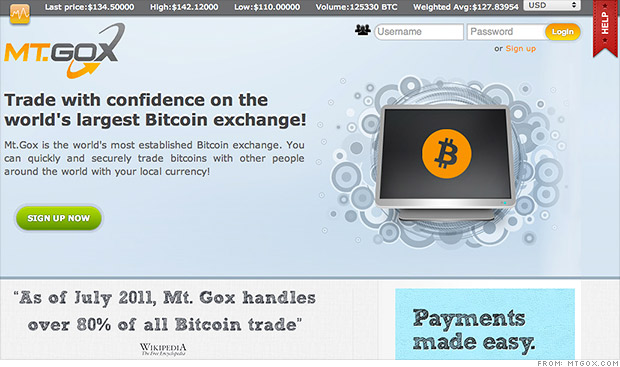
Mt. Gox, a Bitcoin exchange, said it had been hit with a massive cyberattack.
NEW YORK (CNNMoney)

As interest has surged in Bitcoin, platforms that support the digital currency have been hit by damaging cyberattacks this week.


Mt. Gox, a Tokyo-based exchange that claims to handle more than 70% of all Bitcoin trades, said in a statement on Thursday that it had been hit by a massive Distributed Denial of Service attack. In a DDoS attack, hackers direct a giant traffic surge to their target, overwhelming the site's servers and making it hard for legitimate users to gain access.

The attacks appear to have shaken confidence among some Bitcoin users.
On Wednesday, Bitcoins rose to $147, before pulling back overnight to around $115 as word of the cyberattacks spread. Mt. Gox said the attacks may be an effort to prompt "panic selling", with the hackers hoping to buy up cheap Bitcoins following the panic they've created -- and then waiting for the currency to rise again. They may also be aimed more generally at destabilizing the Bitcoin system.
"[R]emember that Bitcoin, despite being designed to have its value increase over time, will always be the victim of people trying to abuse the system, or even the value of Bitcoin decreasing occasionally," the exchange said.
Related: Bitcoin ATMs coming soon
Mt. Gox said it was suffering its "worst trading lag ever," with some users having difficulty logging into their accounts. The company said it was working to make sure the problem didn't become any more serious.
A Mt. Gox spokesman said in an email that individual accounts had not been compromised. The source of the attack, he added, is "difficult to determine."

Bitcoin is a four-year-old digital currency developed outside the authority of governments and central banks and designed to allow worldwide payments between users. The value of Bitcoins has surged in recent weeks amid decreasing trust in traditional banking systems, particularly after Cyprus imposed a tax on top bank depositors and placed limits on withdrawals to help pay for a European bailout.
Increased media attention has also helped fuel Bitcoin's rise. On Thursday afternoon, the value of one Bitcoin was hovering around $130, up from $47 two weeks ago and just 5 cents back in mid-2010.
Andreas Baumhof, chief technology officer at the cybersecurity firm ThreatMetrix, noted that financial institutions of all kinds face attacks like the one that hit Mt. Gox. Because the market for Bitcoin is so much smaller than those for other currencies, he added, such disruptions are more likely to generate big swings in Bitcoin's value.
"If I were to target a big financial institution, in no way would the value of the US dollar fluctuate," Baumhof said.
Related story: The Bitcoin trade is going higher, Higher, Higher!
Other Bitcoin utilities have also reported problems in recent days.
Bitcoin-Central, a site for the exchange and storage of the currency, and affiliated service Paytunia said they had detected a security breach on Monday and suspended operations pending an investigation. The services said Wednesday that they hoped to be up and running again by the end of the week, and that customers' account balances had not been affected.
Instawallet, an online service for Bitcoin storage, had a notice posted on its website Thursday saying it had been "fraudulently accessed," and would be suspending service indefinitely. Users have been instructed to submit claims to recover their funds.
As the Bitcoin business matures, service providers for the digital currency will continue to beef up their cybersecurity in the same way large banks and online-payment firms like eBay's (EBAY, Fortune 500) PayPal have in recent years, Baumhof said.
"I'm fairly sure this will ultimately be just a blip," Baumhof said of the disruptions this week.

Shodan: The scariest search engine on the Internet


Shodan: The scariest search engine on the Internet

"When people don't see stuff on Google, they think no one can find it. That's not true."

That's according to John Matherly, creator of Shodan, the scariest search engine on the Internet.


Unlike Google (GOOG, Fortune 500), which crawls the Web looking for websites, Shodan navigates the Internet's back channels. It's a kind of "dark" Google, looking for the servers, webcams, printers, routers and all the other stuff that is connected to and makes up the Internet. (Shodan's site was slow to load Monday following the publication of this story.)
Shodan runs 24/7 and collects information on about 500 million connected devices and services each month.                                          
It's stunning what can be found with a simple search on Shodan. Countless traffic lights, security cameras, home automation devices and heating systems are connected to the Internet and easy to spot.
Shodan searchers have found control systems for a water park, a gas station, a hotel wine cooler and a crematorium. Cybersecurity researchers have even located command and control systems for nuclear power plants and a particle-accelerating cyclotron by using Shodan.
What's really noteworthy about Shodan's ability to find all of this -- and what makes Shodan so scary -- is that very few of those devices have any kind of security built into them.
"You can log into just about half of the Internet with a default password," said HD Moore, chief security officer of Rapid 7, who operates a private version of a Shodan-like database for his own research purposes. "It's a massive security failure."
Related story: Hackers take aim at key U.S. infrastructure
A quick search for "default password" reveals countless printers, servers and system control devices that use  "admin" as their user name and "1234" as their password. Many more connected systems require no credentials at all -- all you need is a Web browser to connect to them.
In a talk given at last year's Defcon cybersecurity conference, independent security penetration tester Dan Tentler demonstrated how he used Shodan to find control systems for evaporative coolers, pressurized water heaters, and garage doors.
He found a car wash that could be turned on and off and a hockey rink in Denmark that could be defrosted with a click of a button. A city's entire traffic control system was connected to the Internet and could be put into "test mode" with a single command entry. And he also found a control system for a hydroelectric plant in France with two turbines generating 3 megawatts each.
Scary stuff, if it got into the wrong hands.
"You could really do some serious damage with this," Tentler said, in an understatement.
So why are all these devices connected with few safeguards? Some things that are designed to be connected to the Internet, such as door locks that can be controlled with your iPhone, are generally believed to be hard to find. Security is an afterthought.
Related story: If you're using 'Password1,' change it. Now.
A bigger issue is that many of these devices shouldn't even be online at all. Companies will often buy systems that can enable them to control, say, a heating system with a computer. How do they connect the computer to the heating system? Rather than connect them directly, many IT departments just plug them both into a Web server, inadvertently sharing them with the rest of the world.
"Of course there's no security on these things," said Matherly, "They don't belong on the Internet in the first place."
The good news is that Shodan is almost exclusively used for good.
Matherly, who completed Shodan more than three years ago as a pet project, has limited searches to just 10 results without an account, and 50 with an account. If you want to see everything Shodan has to offer, Matherly requires more information about what you're hoping to achieve -- and a payment.
Penetration testers, security professionals, academic researchers and law enforcement agencies are the primary users of Shodan. Bad actors may use it as a starting point, Matherly admits. But he added that cybercriminals typically have access to botnets -- large collections of infected computers -- that are able to achieve the same task without detection.
To date, most cyberattacks have focused on stealing money and intellectual property. Bad guys haven't yet tried to do harm by blowing up a building or killing the traffic lights in a city.
Security professionals are hoping to avoid that scenario by spotting these unsecured, connected devices and services using Shodan, and alerting those operating them that they're vulnerable. In the meantime, there are too many terrifying things connected to the Internet with no security to speak of just waiting to be attacked.

Some early peeks at Facebook Home


Some early peeks at Facebook Home


STORY HIGHLIGHTS
  • Facebook releases Facebook Home ad starring drag queens and cats
  • An early version of the Android skin was leaked Monday morning
  • The app will officially debut on Friday in the Google Play store and on the HTC First phone
The new Facebook Home Android app isn't scheduled to launch until Friday, but the Internet is getting some early peeks.
First there's the quirky new Facebook Home ad, which was released over the weekend. The ad shows a man boarding an airplane while simultaneously flipping through the latest updates on his Facebook Home phone. Each update comes to life around him, with some sunblock-slathered gentlemen stored in the overhead compartments, drag queen Shangela popping out of the service cart, a chocolate-covered nephew blocking the aisle and a couple of cats bounding toward first class, where they belong.
The ad doesn't really share any detailed information about the product, other than pushing the concept that its bigger images and lock screen placement make Facebook so immersive that you might suffer vivid hallucinations in public.
For people interested in a more detailed peek, the smartphone skin and app launcher made an early if short-lived debut on Monday when a prerelease version was leaked online. Tech site MoDaCo successfully installed a version of the Facebook Home app.
The biggest revelation was that the app worked on more Android devices than Facebook has officially named, including Google's Nexus 4 smartphone and Nexus 7 tablet. However, the build wasn't fully operational, featuring a few bugs and lacking the Chat Heads feature, which pulls together messages from multiple services into one tool.
The app has since been disabled on the Facebook side, according to MoDaCo's Paul O'Brien.
Some publications got a more official preview of Facebook Home last week when they got a little hands-on time with the HTC First smartphone.
The HTC First is the first phone that will come with Facebook Home preinstalled. Impressions were mixed: The Verge called the execution of Chat Heads "clever," Engadget thought it was zippy enough for the targeted nonpower users, Wired chimed in that it isn't "fully polished yet" and Gizmodo said it looked responsive.
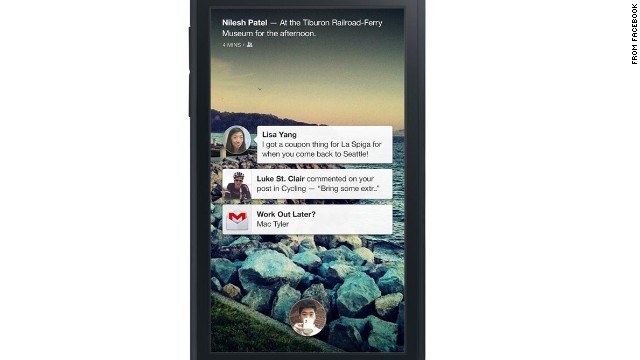
Facebook Home was unveiled on Thursday. The app will add additional Facebook features to the Android mobile operating system, replacing a smartphone's lock screen with a slide show of news feed updates and placing Facebook apps and shortcuts for posting updates, sharing photos and checking into location prominently on the home screen.
The app will be available in the Google Play store for select Android smartphones and come preinstalled on the HTC First starting Friday.